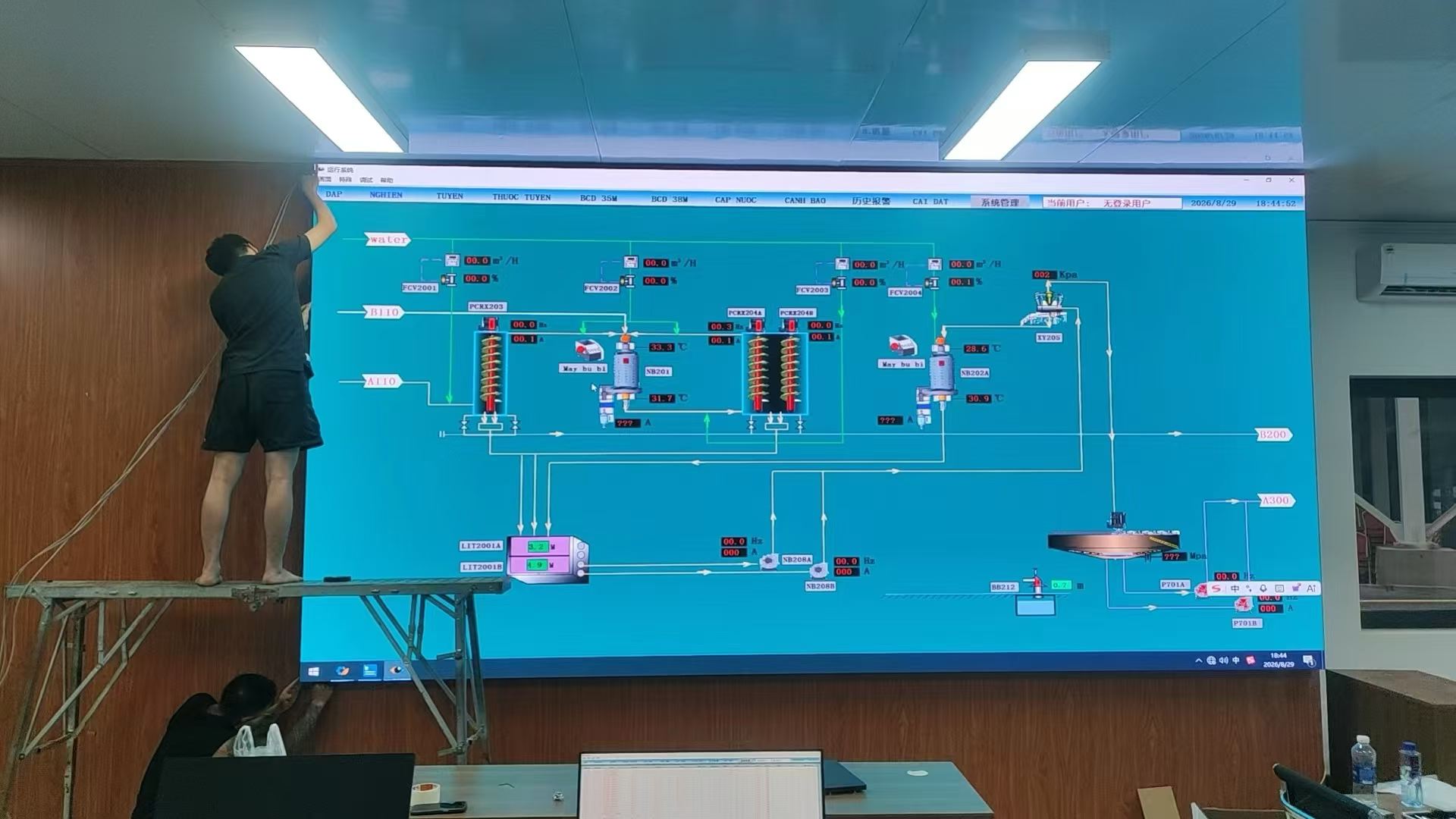
Introduction
This production line combines the characteristics of apatite ore and customizes an exclusive complete closed-loop process. The whole process is mechanized and automated. The operation is: raw ore entering the factory → raw material bin sieve screening to remove large debris and waste rock → raw material bin buffer storage → plate feeder feeding uniformly and quantitatively → first-level drum screen washing and screening to remove surface clay and fine mud → Parallel crushing and shaping of double impact crushers → closed transfer by multi-specification belt conveyors → fine classification and screening by two-stage drum screens → accurate measurement of feed volume by combined belt scales → two-stage grinding and classification operation (coarse grinding by grid ball mill + fine grinding by overflow ball mill + double spiral classification + closed-circuit classification by hydrocyclone) to ensure the completeness of apatite Full monomer dissociation, eliminating over-grinding and sludge → Slurry mixing tank mixing, agent ratio activation → XCF/KYF combined inflatable flotation unit positive flotation separation (roughing, sweeping, selection and sub-section operation, enriching apatite and removing siliceous gangue) → High-grade phosphate concentrate slurry is sent to the peripheral transmission thickener for concentration → Concentrate Stirring and homogenizing buffering; flotation tailings → tailings mixing and slurrying → tailings special cyclone group classification → dehydration screen pre-dehydration → thickener deep concentration → chamber filter press dry press, the entire plant's production wastewater, thickener overflow water, cleaning wastewater are collected uniformly, and the return water system is recycled and reused to achieve green closed-loop production of the entire process.
Detailed configuration
-The plate feeder has a heavy-duty wear-resistant structure and is suitable for wet and large pieces of apatite ore. It feeds materials at a constant speed without clogging or machine jamming.
1 drum screen, pre-washed and screened to efficiently remove clay and fine mud impurities on the apatite surface and reduce subsequent flotation reagent consumption
-Two sets of CI521 impact crushers, two machines operating in parallel, adapted to the medium hardness properties of apatite, with uniform crushing particle size and good shaping effect, fully meeting the 3000TPD capacity load
1 drum screen, back-end fine screening operation, strict classification of materials with qualified particle size, preventing large ore exceeding the standard from entering the grinding system, reducing the grinding load
1 FG-2400×12m spiral classifier, primary pulp classification, preliminary separation of coarse and fine pulp, and stable grinding conditions
- One MQG3245 wet grid ball mill, responsible for rough grinding operations. It has large processing capacity, wear resistance and stable material discharging, and is suitable for large-capacity apatite rough grinding conditions.
One high weir type double screw classifier, high-precision double screw classification, the classification efficiency is much higher than that of single screw equipment, and the particle size of coarse grinding slurry can be precisely controlled
1 hydrocyclone group, closed-circuit fine classification, qualified fineness slurry overflows into the flotation process, and coarse-grained sand is automatically returned to the ball mill for re-grinding, achieving zero-waste closed-loop grinding
One wet overflow ball mill, which performs fine grinding operations and accurately matches the grinding characteristics of apatite to ensure full dissociation of minerals and lay the foundation for high-precision flotation.
XCF-24 inflatable stirred flotation machine, KYF-24 inflated stirred flotation machine, combined flotation unit, divided into divisions to adapt to the whole process of roughing, selection, and sweeping operations, uniform aeration, sufficient mixing, high sorting efficiency, low energy consumption, perfectly adapted to the needs of apatite sorting
1 peripheral transmission thickener, which pre-concentrates the slurry before flotation, stabilizes the slurry concentration and liquid level, and avoids concentration fluctuations affecting the flotation separation effect.
2 slurry mixing tanks are used for slurry mixing and chemical mixing reactions to ensure uniform slurry concentration and chemical ratio.
5 chemical mixing tanks are used for the proportioning, mixing and maturation of various collectors, inhibitors and activators in apatite flotation to ensure stable chemical effects.
- 4 ordinary chemical storage tanks and 2 stainless steel chemical storage tanks, which store acidic, alkaline and oily flotation chemicals in classified areas. The stainless steel tanks are suitable for corrosive chemicals, are anti-corrosion, durable, safe and compliant.
One slurry distributor can evenly distribute the slurry to each flotation tank to ensure consistent separation conditions in each tank and stabilize the overall concentrate grade and recovery rate.
1 mixing tank to achieve buffering and homogeneous mixing of phosphate concentrate slurry, effectively avoiding concentrate precipitation and stratification and concentration deviation, and stabilizing the quality of finished products
One mixing tank is used to mix and homogenize the tailings slurry and evenly transport it to the classification equipment to ensure stable tailings treatment conditions.
2 cyclone groups, grading pretreatment of tailings, separating coarse and fine particle tailings, and improving subsequent dehydration efficiency
2 dewatering screens are used to pre-dehydrate the classified tailings, significantly reducing the moisture content of the tailings and reducing the load on the filter press equipment.
2 mixing tanks, multi-stage tailings buffer mixing, balanced material transportation, and avoid equipment overload operation
1 peripheral transmission thickener, the tailings are deeply concentrated, a large amount of clean water is separated, and the clean water is directly returned and recycled.
2 chamber filter presses, two machines are connected in parallel for press and dehydration. The tailings filter cake has a low moisture content and can be directly dry stacked or utilized as resources.